Choosing the right width and length for 8011 aluminum foil master rolls is an important consideration that has a direct effect on production efficiency, material usage, and overall profitability.
Unlike consumer foil, which is sold in fixed sizes, industrial master rolls are produced in a variety of widths and lengths, which gives customers some degree of flexibility in selecting the size most suitable for their needs in order to fit a slitting line, laminator, or converter.
This article describes the common width and length specifications of 8011 aluminum foil, how to choose the best dimensions for production purposes, and factors influencing the choice of 8011 foil master rolls.
What Are the Common Width and Length Specifications for 8011 Aluminum Foil Master Rolls?
Common Widths of 8011 Aluminum Foil Master Rolls
Master roll width is among the most important specifications.
It influences the ability to convert the foil into finished product widths.
The common width of master rolls ranges from 200 mm to 1650 mm.
Most common master roll widths are 800 mm, 1000 mm, 1200 mm, and 1500 mm.
Different widths are chosen according to different criteria:
Downstream product dimensions: The master roll width should be selected based on the finished product sizes.
For example, household foil is typically slit into 300mm (12 inches) or 450mm (18 inches) widths.
Food packaging laminates may require widths of 600mm to 1200mm depending on pouch size.
Slitting equipment capacity: The master roll must fit within the maximum processing width of the slitting machine.
Widths that exceed or significantly underutilize this capacity can lead to inefficiencies.
Material utilization: Choosing a width that allows for optimal slitting layout minimizes edge trim waste and maximizes yield.
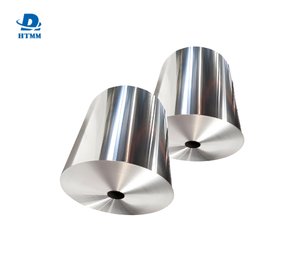
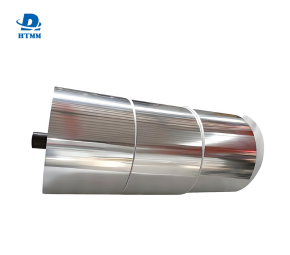
Note: HTMM can produce giant 8011 aluminum foil rolls in a wide variety of widths, from narrow 200mm rolls for specialized applications to wide 1650mm master rolls for high-volume converting.
Custom widths are available to meet specific customer requirements.
What Determines the Length of 8011 Aluminum Foil Master Rolls?
The length of a master roll is not a standard metric.
It is oriented by assessing the connection of thickness, the diameter of the roll, the weight of the roll, and the specifications of the equipment provided by the client.
The length of a master roll is given in meters; however, it can differ based on various factors:
Thickness: Thinner foil (for instance, 9 microns) allows for a longer roll of the same diameter and weight in comparison to a thicker foil (for example, 20 microns).
Roll diameter: The maximum length of the roll can basically be judged based on the outer diameter of the rolls.
Most equipment is made for using rolls with outer diameters up to 1200mm to 1500mm.
Roll weight: The weight of the roll can be so high that it can exceed the lifting capacity of the factory equipment or the load-bearing capacity of the cutting machines.
The width of the roll will remain the same; however, the available length will vary significantly depending on the thickness of the foil.
For instance, a roll of a width of 1200 mm with a 1200 mm diameter would have a different length for the different thicknesses of the foil:
Any 9-micron foil would have approximately 15,000 meters.
The same roll would have approximately 7,500 meters of 18-micron foil.
The roll would have approximately 4,500 meters of a 30-micron foil.
It is clear, therefore, that when you decide to buy a roll, you need to compare not just the "meters" but also the thickness and weight of the roll to understand its true value and usability.
Why does foil thickness have an effect on the available length of the master roll?
The impact of thickness on length is based on the volume and weight factor- given the roll diameter and width:
Thinner foil - has a lower weight per meter allowing more meters to be rolled to achieve a similar outer diameter and roll weight.
Thicker foil - has higher weight per meter resulting in the roll having fewer meters regardless of diameter and width.
Can the Dimensions of 8011 Aluminum Foil Rolls Are Customized?
Yes, both dimensions can be customized based on industrial needs regarding procurement.
Master rolls are made for integration into production processes unlike retail foil that has to be supplied in regular dimension.
The customization includes:
Width: Any width in the limits of what the rolling mill can produce (usually from 200 mm to 1650 mm).
Length: Depends on such parameters as roll weight, roll diameter, and equipment limitations.
The roll weight: usually from 500 to 5000 kg.
The core diameter: standard diameters are 76 mm (3 inches), 152 mm (6 inches), and 200 mm (8 inches); other diameters are available.
The external diameter of the roll: normally it is not more than 1200-1500mm.
Created custom dimensions might help to improve efficiency of processing through:
Minimization of slitting losses through optimal layout.
Reduction of number of roll changeovers.
Safe use of lifting and transporting equipment.
How to Choose the Size of the 8011 Aluminum Foil Master Rolls According to the Production Requirements?
Choosing a Master Roll on the Basis of the Finished Size of the End Products
The first aspect in choosing the size of a master roll relies on the size of the end product.
Various uses have varying width specifications:
Household aluminum foil: Master rolls can be sliced into consumer sizes of 300 or 450mm, which is equivalent to 12 or 18 inches.
Catering aluminum foil requires formats of 450 or 600mm to cover large baking trays and roasting pans.
Food packing and lamination depend upon the size of the pouches, bags, and laminate.
Normal size range is between 600 and 1,200mm.
The best way is first to define the dimensions of the end product and then go backward to the optimal master roll size and the layout for its cutting.
Choosing a Master Roll on the Basis of the Effective Width of the Slitting Machine
The width of the master roll should have the same size as the allowed width of the slitting device.
Some points to consider are:
Too wide master roll cannot be processed.
Too narrow master roll does not allow for the proper functioning
A key point in the technical specification is the maximum processing width of the machine.
The maximum width of the majority of slitting machines varies from 1200 mm to 1650 mm.
In order to optimize the width of the master roll, it is essential to provide the technical specifications of the machine to the supplier.
Why it cannot be simply stated that the wider the master roll, the better?
Although a wider master roll might seem beneficial, it actually leads to a larger amount of slitting waste and lower usage of materials.
Key points to keep in mind are:
Slitting kerf: loss of material during cutting (the slitting kerf of around 2-5 mm for each cut), with the amount of lost material increasing with the number of cuts (the wider the master roll, the more cuts need to be made and the bigger waste produced).
Edge trim waste: when the width of the master roll is either wider or narrower than the total width of products manufactured with slitting plus the amount of kerf waste made during slitting operations, edge trim waste is inevitable.
The width of the master roll should be properly set so that the capacity of the equipment, finished product size, and cutting scheme are balanced.
What is the difference in roll width for different applications of 8011 aluminum foil?
Household foil. Priority is placed on the cutting sizes to be reached in retail–e.g., 30 cm and 45 cm.
Therefore, the width of the master rolls should range from 800 mm to 1200 mm so that it is easy to cut rolls into narrower widths.
Food packaging. The width should depend on bagging, composite film, and the layout of food packaging.
The length of the master rolls is typically 600–1200 mm, while for some pouches, it will be necessary to produce custom widths.
Industrial and other applications. Widths are determined based on equipment and the final size of the product.
There might be cases where non-standard widths would be used.
What should be taken into account when determining the length of the master roll?
What is the relation between roll weight and length?
The relationship between the roll weight, length, thickness, and width can be calculated based using the formula below:
Roll Weight (kg) = Width (m) x Length (m) x Thickness (um) x 2.71 (density
How many rolls can be lifted using the lifting apparatus at the manufacturing site.
How many rolls can be put in a shipping container or on a pallet.
The total shipping weight and cost of logistics.
It is necessary to find out exactly how much weight of each roll should be accepted based on the load-carrying capacity of the lifting, transporting, and other equipment in that particular factory.
For reference, the maximum weight of the master rolls ranges from 500kg to 5,000kg.
The Roll Dia and the ID Matter in the Normal Operation of the Machine
As for the outer diameter, if it is too big, the roll may not fit into the machine.
As a rule, the outer diameter does have limits of 1200 to 1500mm for the major part of machines.
So a roll that exceeds this outer diameter cannot be put in the unwind apparatus.
As for the inner diameter, it is crucial that the roll fits well into the apparatus reel or clump.
The standard inner diameter dimensions are the following:
76mm (3 inches) for minor converting machines.
152mm (6 inches) for many slitting and laminating equipment.
200mm (8 inches) for more serious industrial machines.
Importance of Thickness Tolerance and Length Consistency
When it comes to actual production and thickness uniformity, it impacts the weight of material – that is the reason why thickness variations can lead to the following problems:
Uneven tension while unwrapping may cause web breaking.
Unequal printing, coating, and lamination.
Differences in barrier performance of the finished package.
Stable constraints of roll specifications will provide for an uninterrupted production as it minimizes necessary adjustments.
That is important in mass-production processes such as food-packaging and domestic use aluminum foil, since any downtime in production results in financial losses.
Packaging Method of the Master Roll Matter
Aluminum foil has a very fragile surface, which is easy to scratch and to suffer from exposure to moisture.
Proper packaging of the master roll is important for its delivery and storage – the following factors have to be taken into account:
Proper crates, pallets, or moisture-proof wrapping might bring the roll protection against damages.
Transportation of goods over long distances raises the issue of securing them for transportation and protecting them from moisture.
Some of the packaging methods include:
Polyethylene wrapping that is water-repellent.
Strengthened rolls and edges that offer protection.
Bags that keep the humidity under control.
Steel strapping and edge protection measures in place.
HTMM ensures that the wrapping is to the extent of ensuring that the rolls arrive in the best shape for use.
When buying 8011 Aluminum Foil Master Rolls, how to know what to buy?
Step one: know the equipment.
The following is needed by the vendor:
The width of the machines for slitting or lamination.
The outer diameter of the roll to be unwound.
The inner diameter.
The weight of the roll to be processed by the machines.
Specifications for the slitting or lamination processes.
The second step is identifying the foil specifications based on the final product.
Usage: Residential, food packing, medicine, or industrial purposes.
Desired thickness: Needed to ensure barrier efficiency and strength.
Desired width: Dependent on dimensions of the final product.
Required length of the roll or weight of the single roll: Dependent on the process of producing the roll.
Future processing: Whether slitting, laminated or printed roll is required.
Evaluate Cost per Ton, and Do Not Forget to Evaluate Material Usage
The cost per ton is a significant parameter, but not the only one.
The actual cost per unit of the good product should depend on material usage rates.
Important points to discuss include:
Is the width of the master roll suitable for the slitting plan? Will it result in minimization of the edge trim waste?
How much scrap will be made during slitting?
Will the quality of the roll be able to facilitate stable and continuous production?
The actual cost of materials for the good product is more important than the cost per ton.
A higher cost per ton may provide additional benefits in cost efficiency and productivity of the process.
In what manner does HTMM render specification assistance pertaining to the 8011 aluminum foil master rolls?
HTMM delivers huge 8011 aluminum foil master rolls to businesses in numerous sectors around the globe, including factories, manufacturers of packaging, and firms engaged in food production.
The following defines our scope of operation:
Custom-ordered widths of 200 mm to 1650 mm.
Varieties of the thicknesses from 6 microns to 200 microns, depending on the particular purpose of usage.
Temper ranges from O, H18, H19, H22, H24, H26
Roll capacities from 500 kg to 5000 kg.
Inner diameters in case of specifying roll from 76 mm to 152 mm, 200 mm or being custom made.
Surface treatment could be shiny or matte, embossed or printed.
Apart from the 8011 aluminum foil, we deliver 8079, 3003 and 1235 aluminum foils for different uses.
In case you need bulk rolls, please specify your desired thickness, width, intended use, limitations of the equipment to be used and quantity.