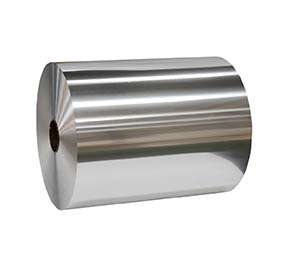
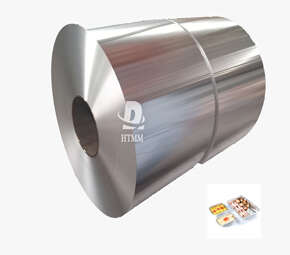
Specification
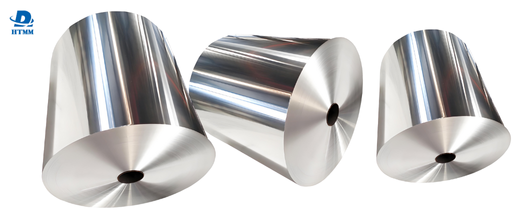
The alloy construction of 8011 provides excellent characteristics for deep drawing, superior corrosion resistance when used as a food contact material, and consistent performance needed by high volume manufactures for reliable production output. The extremely tight tolerance of ±4% in the thickness of the coil ensures that all formed containers will have a uniform wall thickness, thereby avoiding weak spots that would lead to a loss of structural integrity during filling, stacking, or transportation. The brilliant and uniform character of surface finish provide an attractive food contact surface, excellent distribution of heat for cooking purposes, and superior substrate for brand logos printing or embossing when applicable.
Details include:
| Type |
Aluminium Foil for Food Container Application |
| Application |
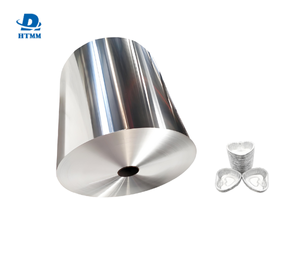
For different food container applications, Such as dishes, plates, trays etc |
| Grade |
Food Grade |
| Alloy |
3003/8011/8006 |
| Temper |
H22 H24 H18 O |
| Thickness |
0.03MM-0.15MM |
| Width |
200MM-1300MM |
| Surface |
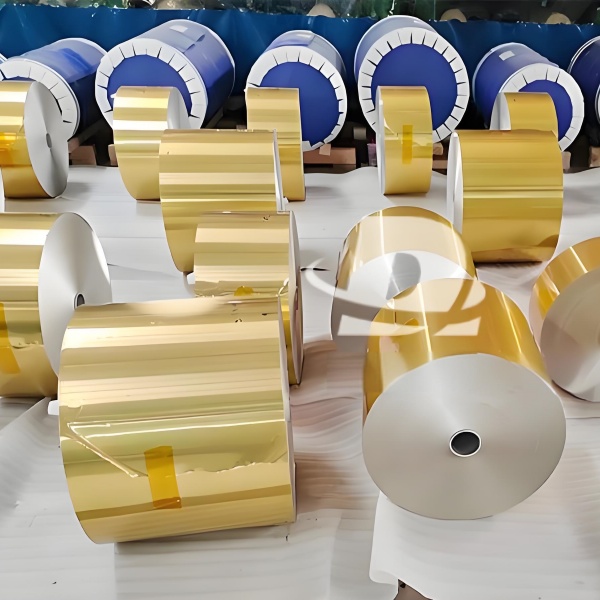
Both sides bright |
| Packaging |
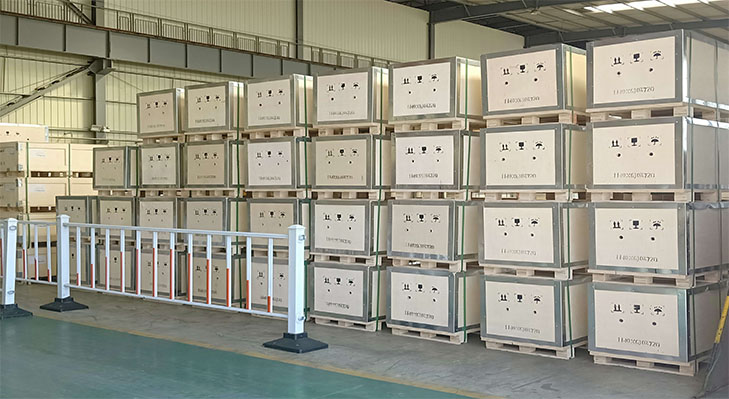
Free Fumigated wooden box |
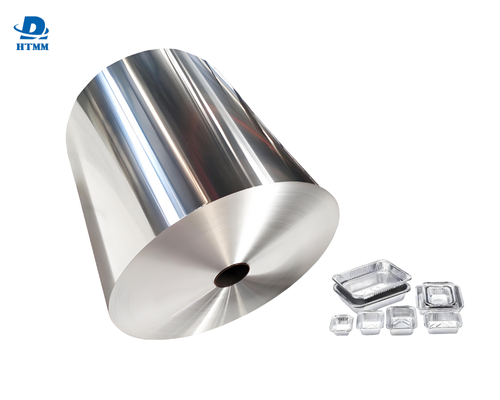
HTMM's aluminum foil 8011 H24 is the primary raw material used to make all ranges of semi-rigid aluminum food containers found throughout the world in food service, retail baking, and industrial catering. For food service container manufacturing, the H24 foil is formed into takeaway trays, delivery containers, buffet pans, and airline meal trays that must endure being filled, stacked, transported, and reheated without losing structural integrity and food safety.
The H24 temper allows for the greatest amount of formability to maximize production efficiency and maintain the right amount of rigidity to ensure reliable performance. In baking applications, the foil is formed into pie plates, cake pans, muffin tins, roasting trays, and pizza pans that will perform properly at temperatures up to 220°C.
In addition to forming properly, the 8011 alloy provides excellent thermal conductivity and corrosion protection. Retail food packaging uses the container foil to package pre-packaged fresh and frozen foods for sale in supermarkets, where uniformity in container quality, the integrity of lids for sealable containers, and the ability to stack the product are all very important to efficient supply chains and consumer satisfaction. The catering and bulk food service market utilizes our heavier gauge aluminum foil 8011 H24 for large containers, compartment trays, and portion packs for bulk feeding in institutional settings, banquet operations, or catering of large special events.
When you choose HTMM as your source for 8011 H24 Aluminum Foil for Containers products, you will benefit from our metallurgical expertise and technical knowledge, our state-of-the-art manufacturing capabilities, and the exceptional level of customer service we provide to help you optimize the forming of your containers. The use of our metallurgical and technical knowledge to assist you in selecting the optimal thickness, temper, and mechanical property range for your container design, press equipment, and production targets, ultimately results in maximum yield and product quality.
With our advanced manufacturing capabilities, such as precision rolling mills, controlled annealing furnaces, and automated thickness monitoring systems, we can produce consistent quality and mechanical properties across every coil we manufacture. We offer total custom solutions for your specific needs, including slitting to exact blank widths for your specific forming presses, optional food-grade lubrication for improved forming and extended tool life, and edge conditioning to provide improved handling and reduced dust.
Our quality assurance system consists of real-time mechanical property testing, surface inspection, and dimensional verification to ensure that every coil meets the stringent standards necessary for high-speed container press operations. We provide complete certification documentation consisting of detailed mechanical property reports and dimensional verification, as well as food safety compliance certificates, which provides the confidence that all quality-centered container manufacturers require.
FAQ
1. What makes 8011 H24 the best choice for container production? 8011 H24 is an excellent choice for making semi-rigid containers because it strikes a good balance between strength and the ability to shape easily. When compared to O temper, 8011 H24 has a higher degree of rigidity and dent resistance for stackable containers, but has large enough elongation (3% to 8%) to allow for deep drawing without cracking.
In addition, 8011 H24 is a much better value than 3003, while still providing good performance in most container applications.
2. What thickness of 8011 H24 is typically used in food containers? 60 to 90 microns (0.06 to 0.09mm) is the typical range of thickness for standard food containers like pie plates, takeout trays and baking pans. Thinner gauges (30-50 microns) are usually used for lightweight containers. Thicker gauges (100-120 microns) are used for heavy-duty containers because they require maximum rigidity and durability. Our technical staff would be happy to recommend the best thickness for your particular container design.
3. Is 8011 H24 container foil suitable to use as an oven-safe container foil?Yes! The 8011 H24 container foil is extensively used for various baking trays, pie pans, and roasting pans. This foil also has excellent heat transfer characteristics allowing for even cooking of foods baked within aluminum foil product. The foil can withstand temperatures of up to 220 °C and will retain its structural integrity during the entire cooking period. Furthermore, the foil is certified for direct food contact, meaning there will be no taste transfer between the foil and the food baked in the foil.
4. What are the most critical quality parameters for container foil raw materials?These critical parameters are consistent width tolerance (±4% or better), uniform mechanical properties (tensile strength, yield strength, elongation), clean surface with no defects or scratches, good flatness to ensure press feeding reliability, and consistent thickness tolerances during the blanking process. Each shipment is checked for these parameters.
5. What types of technical assistance do you have for your container manufacturers?We provide various types of support to our container manufacturers, including assistance in selecting alloys and tempers, optimizing press settings (blankholder pressure, draw speed, and temperature), troubleshooting forming problems such as cracking, wrinkling, or earring, optimizing tooling life, and collaboratively assisting with custom specifications for unique designs. Our technical team has many years of experience in high-volume production of all types of containers manufactured worldwide.

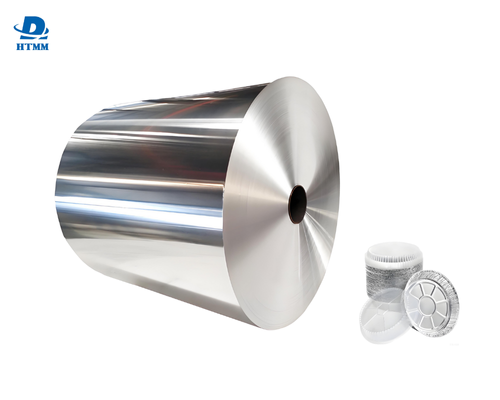
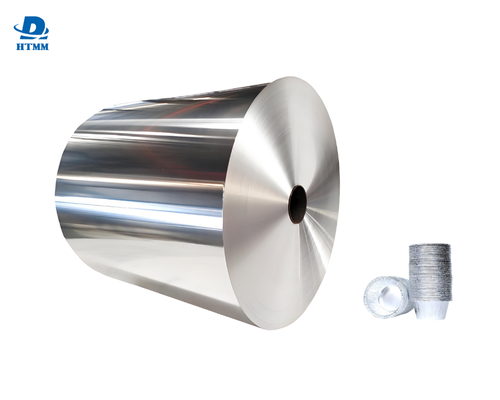
.png)