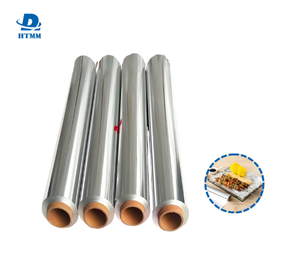
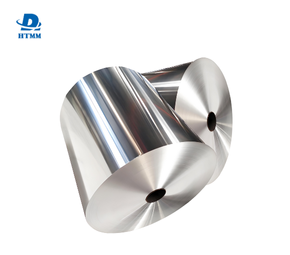
Packaging in the flexible form has conquered the market of food, dairy products, snacks, pharmaceuticals, and hygroscopic goods worldwide.
We can say that the 8011 aluminum foil is the main barrier layer providing excellent protection from the light and oxygen impurities as well as moisture safe level that influences the shelf life, and product safety significantly.
International packaging companies need not only good‑quality aluminum jumbo rolls but also stable parameters of the finished product, constant technical support, and noneffective export logistics.
Being a specialized firm in manufacturing aluminum foil HTMM provides a complete cycle of services from specification confirmation to rolling, delivery, and transportation.
How 8011 foil specifications are set at HTMM depending on client needs
Various packaging companies have specific processes, such as lamination and printing, and the end products have different specifications regarding the materials used.
Thus, HTMM’s specialists begin each project with figuring out what specifications need to be set according to the downstream processes of the client and what final packaging application is planned.
First of all, HTMM establishes the thickness of foil according to its application.
8011 foil of smaller thickness will be used for producing cheaper packaging for snacks as it does not need to provide high light barrier performance while being cheap.
Thicker foils are used for high barrier purposes, such as retort pouches manufacturing, or milk powder and pharmaceutical films production, as greater thickness reduces the chances of forming tiny holes and helps improve barrier properties.
Second, the width of the jumbo roll is tailored to conform with the client’s slitting and laminating equipment.
HTMM determines the width of the parent roll based on the slitting configuration of the converter, to ensure optimum material utilization and minimum waste of edge trimmings.
The engineers evaluate the entire slitting design of the customer in terms of the number of finished narrow rolls and edge wastage to make sure the provided jumbo roll can be used in the high performance composite lines without any additional processing.
Third, HTMM opts for "8011‑O fully annealed soft temper" in the majority of flexible packaging applications.
O temper is differentiated by high ductility and elongation meaning the foil is resistant to lamination processes, folding and shaping operations.
The soft feature of 8011 alloy ensures uniform printing and stable bonding with the films based on PET and PE, which are essential for high speed composite production.
For special purposes with higher rigidity requirements, HTMM can suggest other types of temper, while the 8011‑O remains the most widely used grade for flexible laminates.
In conclusion, HTMM has established core jumbo roll specifications such as the core inner diameter, highest outer diameter, roll net weight, and outer packaging.
Buyers can determine using aluminum or paper cores, rolling weight, and coil diameter because HTMM keeps records of these details in the technical specification sheet before production, and thus, avoids any miscommunication between the company and its international customers.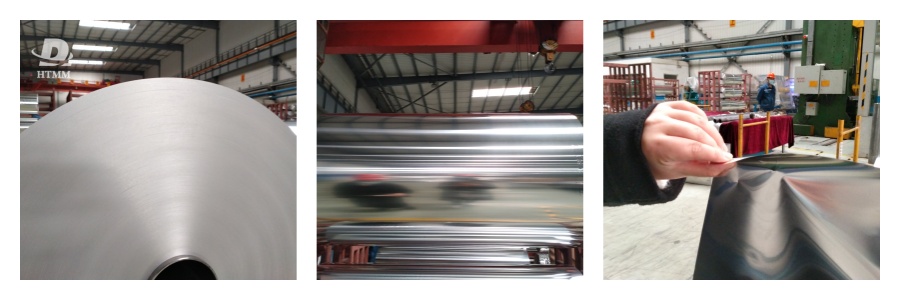
The production process of HTMM for jumbo foil rolls of alloy 8011 applicable in flexible packaging
Following the confirmation of specifications, HTMM begins the regulated procedure for the manufacturing of alloy 8011 jumbo rolls for lamination purposes.
Alloy 8011 belongs to the Al‑Fe‑Si group and exhibits optimal mechanical strength and ductility attributes upon full annealing.
Alloy 8011 exhibits better tearing properties in comparison to pure aluminum and entails excellent formability features required in the flexible packaging sector.
Manufacturing of thin aluminum foil comes down to quality rolling technology, which HTMM practices with the help of the multi‑pass cold rolling technique and real‑time monitoring of thickness.
In the case of thin foil specifications of alloy 8011 used in packaging, both the rolling speed and reduction ratio are controlled so that the consistency of foil thickness across the whole foil is maintained.
In the process of rolling, tension management plays an important role in the prevention of issues with uneven elongation, camber, and waviness, which lead to breakdowns of the packing lamination equipment.
Surface quality and pinhole management are important factors when it comes to flexible packaging foil.
Pinhole formation can lead to compromised water and oxygen barrier properties thus affecting the shelf life of packaged products.
HTMM strives to control the quality of the raw material casting process, purity of the rolling oil, and the state of the surface of the rolls in order to minimize pinhole formation.
In addition, the company installed online inspection systems, which can detect the presence of pinholes, scratches, oil stains, or contaminants on the foil surface.
The final step of the jumbo roll production process is quality control of the winding process.
Achieving flat and even winding quality is necessary to ensure the proper unwinding process at the customer's composite and slitting machines.
Mistakes in winding can lead to telescoping and wrinkles, as well as tension fluctuations that can result in either the delamination of the composite or breakage of the foil.
HTMM controls and maintains the tension and edge alignment during the winding process, thus ensuring the perfect delivery conditions of the jumbo roll to the customer's factory in order to prepare it for further lamination and slitting.
How HTMM ensures consistent quality in bulk orders
Bulk orders mean consistent quality levels are very important for international packaging manufacturers.
Differences in thickness, elongation, and surface quality will make converters alter production parameters more often, resulting in waste and unsteady finished goods quality.
HTMM ensures minimal tolerance for thickness and width.
The deviation for thickness stays within given tolerance levels, while width control is so strict that trimming loss can be minimized.
Each coil is sampled and tested at the in‑house laboratory before going out to the customer.
The entire inspection process takes place and ensures proper control over pinhole counts, surface defects, and edge conditions.
The production inspection makes sure that no edge burring or cracks are like the result of the production process.
The process of testing consists of several steps, including the mechanical characteristics verification to confirm that the required 8011‑O temper is reached.
A unique approach called HTMM normalizes the effect of manufacturing processes on material qualities.
The manufacturing process includes strict parameters related to melting, casting and rolling.
Raw materials used for production are ingots of aluminum with set composition.
The conditions of annealing remain identical for all lots of aluminum manufactured.
The final quality control is carried out prior to the shipment of the product.
The quality department inspects coil, test documents and technical papers.
Certificates stating the quality of the material and related documents necessary for customs clearance in case of the clients’ inspection are prepared.
Quality control is carried out separating any coils that did not pass the test and sending them for repairs.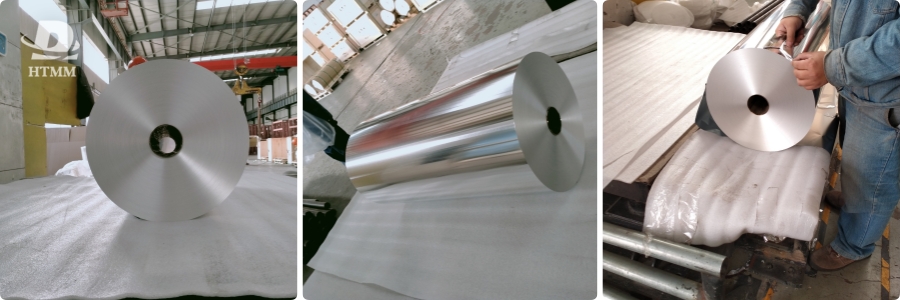
The Luxury of HTMM in the Export Shipment of Jumbo Aluminum Foil to Global Clients
Production schedules are planned according to the quantities of orders and lead time.
In case of large full container loading shipments, production schedules will be organized in advance to avoid production interruptions caused by equipment maintenance activities or delays in the supply of raw materials.
In addition, trial production orders can be placed by potential clients to test the materials before contracting for large‑scale supplies of jumbo aluminum foil.
There are certain risks associated with sea transport.
HTMM ensures that aluminum foil jumbo rolls are professionally packed for export purposes.
Each coil is covered with a moisture‑proof film and a desiccant, and all rolls are placed in wooden cases that have undergone a special treatment for pests.
Custom labeling and container loading plans are formed in compliance with the customers' requests.
The HTMM prints coil labels containing alloy, temper, thickness, width, net weight, batch number and QR traceability code.
The customers can provide special requirements concerning the language and text of coil labels.
The logistical department comes up with container loading scheme in which maximization of cargo space is performed with no coil interference while in transit.
HTMM provides full export support for full‑container international orders.
The delivery documents, packing lists, certificates of origin as well as reports on material tests are processed timely.
The sales and logistics departments monitor the status of delivery and inform the customers about the process of container loading, sailing and arrival plan on the destination.
If the customers presence certain requirements on the port clearance or customs, the documentation is processed according to their needs.
The reasons why international packaging producers choose HTMM as their 8011 foil supplier
In the first place, HTMM is a direct producer of aluminum foil and therefore avoids unnecessary middlemen.
This allows packaging manufacturers to take advantage of the best pricing when it comes to ordering jumbo rolls in bulk.
The stable manufacturing capacity of HTMM makes it possible to deliver orders of any size and offer competitive prices for long‑term projects.
In the second place, HTMM provides a wide range of customization options in terms of thickness, width, weight of coils and packaging specifications which are required for packaging production purposes.
Unlike many competitors who specialize only in ordinary dimensions, HTMM cooperates with packaging converters in the process of creating jumbo rolls which would be compatible with their slitting and lamination processes.
Finally, overall reliability of the foundry guarantees consistent supplies and makes it easier to establish long‑term contracts.
Many international producers cannot afford material shortages as the production of their products is continuous throughout the year.
As a result, HTMM keeps some of its manufacturing capabilities reserved for its important customers which makes it possible to satisfy all types of orders at the same time.
Fourthly, HTMM offers a wide variety of packaging aluminum grades which includes 8011, 8079 and 1235.
The packaging manufacturers can procure different grades of foil from a single vendor for various applications for example 8011‑O grade is used for food packaging foil, 8079 grade is used for pharmaceutical foil and 1235 grade is used for high purity applications.
Thus sourcing becomes easier and less complex.
When it comes to selling 8011 flexible packaging foil to packaging manufacturers it is much more complex than just producing jumbo rolls of aluminum foil.
This process involves ensuring technical specifications compliance, performing accurate rolling, implementing strict quality checks and doing export packaging.
This is why HTMM combines its material expertise with the production capacity and export services to become a reliable raw material supplier for packaging manufacturers.
If needed, I can output all your previous foil articles combined into one full‑split document.