Today’s food, packaging and pharmaceutical industries utilize aluminum foil as the primary barrier material.
There are three widely-used foil alloys in flexible packaging notably 8011, 8079 & 1235 that have gained immense popularity amongst packaging convertors around the world.
All these foils are proficient in performing their tasks such being light-blocking, moisture-proof and oxygen resistant but they vary considerably in the area of composition, characteristics, processing flexibility and uses.
The choice of the particular alloy is crucial since it impacts the stability of the production process, shelf-life of the end product and cost of a particular project.
8011 and 8079 are regarded as members of the 8xxx aluminum range characterized by iron and silicon alloy systems; 1235 is known to be of the family of pure aluminum alloys with 99.35% minimum aluminum content.
8011: Contains both iron and silicon in balanced proportions (0.60-1.00% and 0.50-0.90% respectively).
Iron and silicon tightly incorporated into its composition enhance tensile properties and rolling stability, but moderate amount of silicon does not provide a lot of ductility as compared to 8079.
8079: Features the highest content of iron and lowest content of silicon (0.70-1.30% and 0.05-0.30%, respectively).
Lower silicon concentrations lead to less brittle material; higher iron content creates best grain structure allowing for high elongation ratio and lowest pinhole rate for ultra-thin gauge produced.
1235: Aluminum purity is extraordinarily high, so iron and silicon impurities are extremely low as well.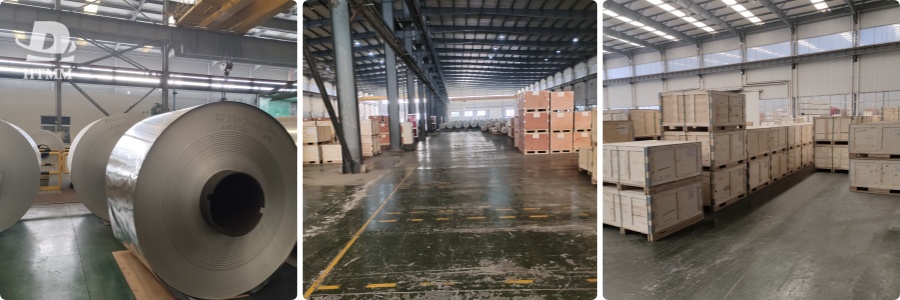
It manifests itself as very soft and ductile material, but has a low tensile strength compared to 8xxx alloys series.
8011 aluminum foil has some basic attributes like a moderate level of tensile strength, reliable performance for rolling and good resistance to corrosion.
Furthermore, its mechanical properties and cost efficiency are balanced, and that is precisely the reason why 8011 is one of the most widely used varieties of packaging foil.
It performs well in various processing environments and allows implementing numerous packaging tasks without the need for high raw material costs.
Foils serve as effective barriers and prevent the penetration of light, oxygen, and water vapor.
Aluminum foil provides high-density metallic barrier, which is capable of blocking light, limiting oxygen penetration, and controlling the water vapor movement in order to protect the contents of the packages.
It is important to keep in mind that it is by no means only alloy grade, which determines favorable barrier properties.
In fact, the barrier performance depends on foil thickness, the number of pinholes, and postlamination configuration to a large extent.
Thus, thinner foil has more pinholes when produced under the same conditions which in turn affects the barrier ability in terms of moisture and oxygen.
Even if the foil is of the highest grade 8079 or 1235, perfect barrier cannot be reached in the presence of an excessive number of pinholes.
Laminated foils with PE, PET or coated layers can also compensate for foil shortcomings and enhance overall barrier properties.
Thus, no alloy has the ability to provide the marvelous barrier properties for any product.
The gap between the alloys remains small at the identical thickness, number of pinholes, and composite structure.
The Distinctions between Ductility and Flexibility
Flexibility is an important property of materials used to produce flexible packages.
It is essential that the material retains its quality and remains intact during the processes of folding, laminating and forming, especially in the case of very thin foil under the thickness of 12 microns.
-8079: Possesses excellent ductility and toughness and shows great performance in repeated folding and forming.
It has a low possibility of breaking in the production of ultra-thin flexible packages.
-1235: High purity provides for soft property and good ductility which is needed for sensitive composite packaging.
-8011: Provides good ductility balanced with strength.
Its strength does not mean very high softness but rather good mechanical properties.
It is used in applications where both strength and flexibility of processing are important such as household foil and medium flexible packages.
8079 and 1235 prove to be efficient for certain flexible packaging applications.
Meanwhile, 8011 is effective in cases when both mechanical strength and manufacturability have to be taken into account.
The Impact of the Three Alloys on Processing
Various processes, including slitting, laminating, coating, printing, and heat-sealing, necessitate different characteristics of the aluminum foil base material.
Slitting requires coil stability.
Correct winding tension eliminates the occurrence of wrinkling, slant edges, and web jumping while slitting.
Meanwhile, lamination and coating call for clean, uninterrupted foil surfaces, since remaining oil or any scratches lead to poor adhesion between foil and polymers.
The printing, coating, and heat-sealing methods require matched values of surface tension and flattening.
The coherence in thickness and surface defects determines the yield in continuous production.
A high variation in thickness and pinholing may lead to frequent shutdown of machines and scraps.
Typical Uses of Different Alloys in Packaging
8031: uses of aluminum foil in households and for purposes of food packaging.
It is useful in cases where production is done on a mass scale with the aid of technology.
8079: uses in different businesses as flexible packaging material, food packaging materials, and blister packs for pharmaceuticals with better quality and low ratio of pinholes.
1235: usage of high-quality aluminum where necessary.
It is highly important to delve into particulars of the process of doing the packaging itself.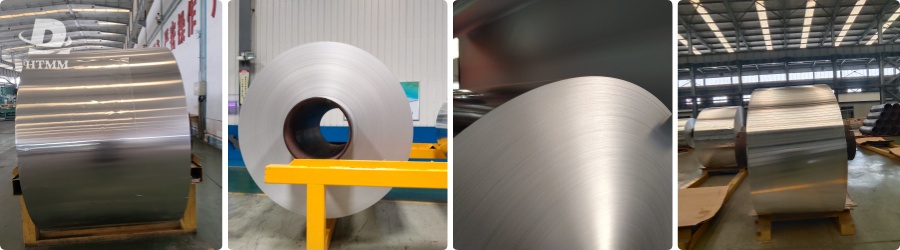
Choosing Between the 8011, 8079 or 1235 Based on Packaging Needs
Important Aspects of Food Packing
First and foremost, packaging engineers should examine food items and storage conditions.
Using a variety of products, we observe various kinds of food that have different degrees of vulnerability to humidity, light and oxygen.
Establish barrier requirements before determining foil thickness and mechanical properties.
Also be aware of possible lamination of PE, PET and paper substrates, since usage of composite structure will lead to the discovery of real load carried by aluminum foil layer.
Selection of Medical and High Barrier Packing
In the case of medical packing, strong specifications of blockading water, oxygen and light are required.
Pinhole frequency, surface characteristics and consistency of thickness become vital factors.
Packages for blisters, sachets and composite medicine bags all have their own mechanical characteristics and barrier needs.
Manufacturers need to use corresponding alloys and foil design based on at the end product.
The reason thin-gauge flexible packaging commonly uses 8079 and 1235 alloys.
Ultra-thin foil requires high levels of ductility and stability when processed.
During the production of foil through lamination, it must stay intact when subjected to tension and bending.
The incorrect foil material choice may lead to breaks, wrinkles and low yields.
Manufacturers have to choose alloys based on the capabilities of the machines in use and the required thickness of the final foil product.
When is the use of 8011 alloy recommended?
8011 allows to combine good strength and processing characteristics.
8011 foil can be found in the production of household and food packaging foil varieties.
The choice of many manufacturers lies on the usage of 8011 alloy due to the possibility to create an unlimited supply strategy for their inventory.
Factors to Compare While Looking for 8011, 8079, and 1235 Aluminum Foil Jumbos
Always Verify Foil Thickness in Addition to Alloy Grade
The structure of the packaging is crucial as it is directly correlated to the thickness of the foil.
Foil thickness determines barriers’ performance, resistance, and cost.
Thinner foil rolls and thicker ones are moved and processed differently.
The same type of foil with different thickness characteristics leads to different end-user results.
Match Coil Weight and Jumbo Roll Width with Production Equipment
The diameter of the jumbo roll should comply with the dimensions of the product after slitting.
The limitations of the said equipment should be observed for slitting.
The coil weight should match the machine’s lifting capacity, and the impact and outside diameter must meet the requirements of the customer’s equipment.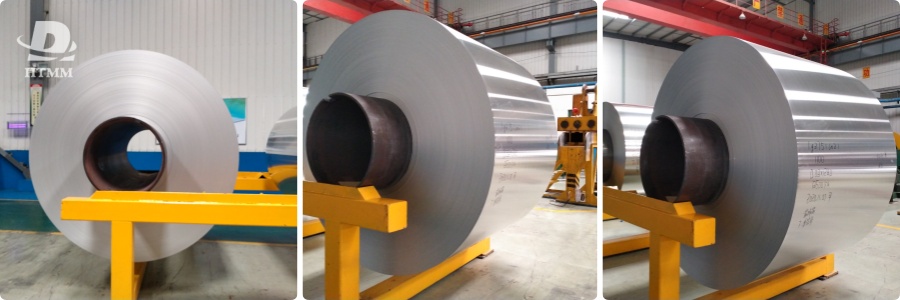
Key Quality Standards to Consider When Buying Bulk
When buying large quantities, it is crucial to check not only the thickness of the foil but also its tolerance, its width, its tolerance, cleanliness, defects, pinholes, appearance of winding, and end face quality.
HTMM supplies large foil rolls of alloys 8011, 8079 and 1235 to the manufacturers of packaging
HTMM offers large aluminum foil rolls of alloys 8011, 8079 and 1235 in compliance with the requirements of packaging manufacturers who disguise themselves as converters, helping them with developing suitable gauging parameters.
All thickness, width and coil-weight specifications can be customized to suit individual customer’s requests.
Our products are in high demand with our industrial clients worldwide, such as food manufacturers, as we keep firm control of raw material supply chain and utilize our effective rolling technolog.