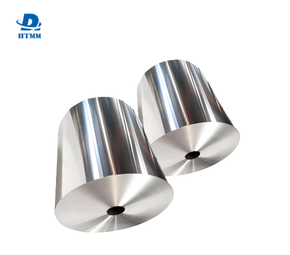
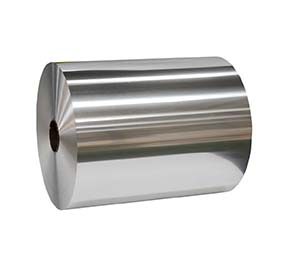
Choosing the correct width and length for master rolls of aluminum foil 8011 is key to maximizing manufacturing efficiency, reducing waste, and assuring compatibility with subsequent processing machines.
Unlike the foil sold in stores, industrial master rolls provide a lot of possibilities for tailor-made master rolls as per specific requirements.
In this article, we will discuss different widths and lengths available, how to choose them, and how to determine the necessary characteristics for your manufacturing needs.
Width and Customization
Width of master rolls is flexible due to slitting, laminating, and finished product sizes coming into play.
The choice of width influences how the materials are used and how effective the conversion process will be.
The width varies: 200mm–1650mm, 800mm, 1000mm, 1200mm, and 1500mm being the common example.
Customization: HTMM manufactures aluminum foil master rolls according to the client’s equipment and needs.
Whatever you need a narrow master roll or wide one, we ensure that it will be produced according to your specifications.
Important: The choice of the width of master rolls is determined by the size of the final product and slitting plan.
Roll length is subject to various factors affecting it, such as the following:
Thickness of foil: A thinner foil makes longer rolls come out for the same roll diameter, but a thicker foil results in a heavier roll for the same length of it.
Roll diameter: The outer diameter of roll limits the maximum length possible to be rolled.
However, normally most equipment allows rolling to a roll with the outer diameter of 1200mm up to 1500mm.
Weight of roll: A heavier roll is more difficult to handle.
For that reason, a weight of a roll is sometimes a more effective measurement than its length.
Production machines: The peculiarities of slitting, laminating, or converting machines determine the best roll length.
For example, a master roll of 1200mm in width and 1200mm in outer diameter may consist of 15000 meters of a 9-micron foil, but only 7500 meters of the foil thickness of 18 microns.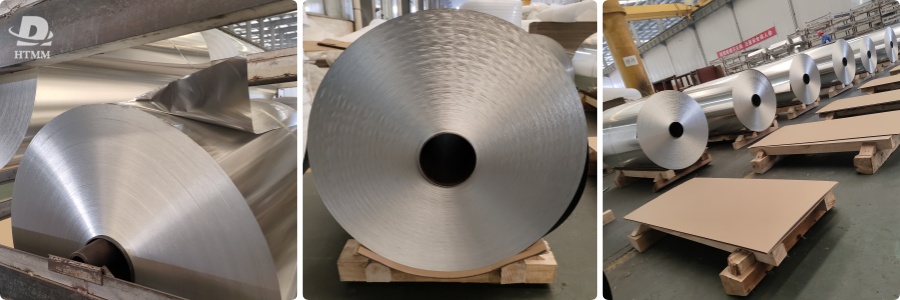
Customizable Roll Characteristics
Industrial rolls can be custom made concerning width, weight and dimensions as opposed to being confined to precast sizes.
The following are the custom options available:
Width: any width possible according to the rolling mill facilities.
Roll weight: normally between 500kg and 5000kg according to the capacity of the equipment used.
Inner diameter of the core: standard sizes including 76mm (3 inches), 152mm (6 inches) and 200mm (8 inches) are offered while other sizes can also be made.
Outer diameter of the roll: it can be anywhere between 1200mm to 1500mm.
Advantage: rolled design provides flexibility in cutting avoiding waste thus facilitating better production process.
Choosing the Correct 8011 Foil Master Roll Width
Evaluate Final Products Specifications
Choose width according to the usage of the product:
Household foil: Master rolls are usually slit into consumer sizes of 300mm (12 inches) or 450mm (18 inches).
Catering foil: More extensive formats of 450mm or 600mm are needed for big baking trays and roasting pans.
Flexible food packaging and composite packaging: The width is determined by the size of the pouch or the lamination meaning use backward deduction from the finished product size to master roll width so you would have the most efficient slitting pattern.
Check Slitting Machines Effectiveness Capability
The width of the master should rescue the productive width of the slitting machine so it does not belong to put too wide or too small because it is not productive enough.
Restrict Overall Width
Excessive width means unnecessary edge trimming waste.
An ideal width shows the balance of capacities and demand of orders.
Dimensions of Foils for Multiple Uses
Domestic foil: Common consumer sizes consist of 300mm and 450mm.
Food wrapping: Depends on the setup of the packing process; width depends on the bagging process, composite plastic films, and final pouch sizes.
Industrial and other uses: Allows for complete customization according to machinery and the final product.
Main Additional Measures for Determining Length of the Roll
Influence of Weight on the Length of the Roll
Thickness, width, length, and weight of the foil are connected.
The rules are:
Roll Weight (kg) = Width (m) × Length (m) × Thickness (µm) × 2.71 (weight).
For bulk purchase, roll weight is more sensible than simple length, as it decides the way of handling, transportation, and equipment compatibility.
The needed weight of the roll should reflect the machine capacity.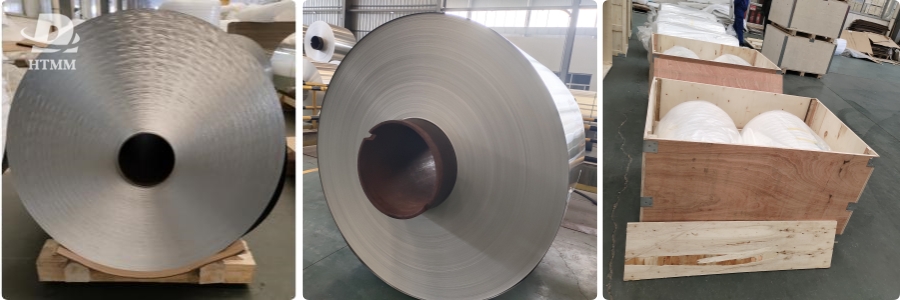
Size of Roll and Inner Core
External size: Must be suitable for the machine unwinding equipment.
Most machines have limits of maximum outer diameter (in most cases up to 1500mm).
Inner core dimensions: Should be compatible with the reel or clamp of the unit.
The standard sizes consist of the following: 76 mm, 152 mm, 200 mm.
Thickness tolerance and length consistency
Proper thickness consistency implies that the weight is the same, resulting in effective mass production.
Changing the thickness will lead to winding tension problems, printing defects and inconsistencies in barrier properties.
Packaging and transportation
Customized packaging that is waterproof and shockproof is used when sending goods to avoid scratching, wet states, and deformation of goods.
If rolls are shipped over long distances, delivery methods that include waterproof packing, additional protection for edges and moisture-absorbing bags should be applied to keep the goods in the right condition.
General Procedure to Verify Correct Master Roll Specifications
Provide Basic Equipment Information
To pick the proper master roll, share details about the machine with the vendor:
Max processing width of slitting or lamination machines.
Acceptable outer and inner diameter of the roll.
Maximum mass of the roll that the technology can support.
Clarify Product and Processing Requirements
Indicate the following:
End product use (household, food packaging, pharma, or industrial).
Planned thickness and width.
Roll mass or length.
Subsequent processes (slitting, lamination, printing, coating).
Analyze Material Economic Efficiency
Concentrate on how much material is actually used and how uniform the production process is.
Remember:
What is the amount of edge trim waste?
Is the roll able to deliver necessary quality?
What is the price of every qualifying unit?
The price that is slightly higher per ton is easier to accept if it helps to produce less waste and gain more profit.
HTMM provides tailor-made 8011 aluminum foil master rolls to food manufacturers and packaging industries across the globe, offering unique specifications based on customer requirements and equipment specifications.
Our capabilities include:
Custom widths of our products: from 200mm to 1650mm.
Thicknesses of the product: ranging from 6microns to 200microns.
Temper options: O, H18, H19, H22, H24, and H26.
Roll weights: ranging from 500kg to 5000kg.
Inner diameters: 76mm, 152mm, 200mm, or custom.
Besides 8011 aluminum foil, we provide 1235, 3003, and 8079 series aluminum foils to cater to different packaging and industrial needs.
Moreover, we give you a one-stop solution through bulk procurement ensuring steady supplies, quality products, and specifications.