The best Chinese aluminum foil factories need to have internationally recognized certifications to meet the needs of the global food packaging, pharmaceutical, and industrial markets.
These credentials help the product meet strict regulatory standards, reduce supply chain risks and build confidence with buyers around the world.
Proper certification is essential for alloys such as 8011, 3003, 8079 and 1235 to ensure food contact safety, manufacturing consistency and commitment to environmental responsibility.
This guide looks at the key certifications that distinguish top tier suppliers from commodity traders.
1.Food Contact Safety Certifications
FDA food-grade compliance certification is essential to assure the U.S. market that HTMM's 8011 household foil and 3003 container foil are made according to the rules of the FDA Food Contact Substances (FCS) program.
These food-grade certifications guarantee that the raw materials used in making foils are considered safe for food contact usage.
As for the European market, all heavy-duty food trays and flexible packaging imported to Europe must comply with the resolution EU CM/Res(2020)9 and regulation (EC) No 1935/2004.
These acts are absolute necessities for packaging materials since they specify certain criteria for materials in contact with food.
It is through SGS laboratory tests and substance migration tests done that heavy metals and the purity of substances used in the production are analyzed.
Top producers utilize SGS testing in order to certify the safety of the materials used.
Such certifications are indispensable so that food producers can avoid risks associated with contamination and recalls
2. Systems for Quality and Manufacturing Management
The ISO 9001:2105 quality management guarantees consistent quality in aluminum foil rolling.
HTMM employs this standard to ensure micron accuracy for the thickness of the 1235 and 8079 ultra-thin foils produced.
ISO 14001 and ISO 45001 reinforce the commitment to sustainability and safety of employees and this enhances the attraction of international companies that prioritize the environment.
The traces and processing of products are available from the aluminum ingots to the finished jumbo rolls thus making it possible to track the tensile strength and elongation characteristics of certain batches.
Continuous improvement and defect prevention lessen the number of occurrences of such problems as edge damage and cracking as well as oil remaining on the product surface during high-speed slitting.
3.The BRCGS Global Food Safety Packaging Standard
The BRCGS Global Food Safety Packaging Standard is a necessary requirement for all factories that produce 1235 and 8079 extremely thin foils used for aseptic packaging of liquids.
The successful passing of the BRCGS certification guarantees that the final product is produced in a completely dust-free environment.
Kosher and Halal certification ensure that the final product is suitable for different cultural and religious customs when it comes to the products used in the household kitchen foil and food service.
Technical verification of pinhole count and wetting tension are also necessary for the third-party certifications to be accepted in the worldwide market.
Besides that, laboratory report of the factory must also confirm the compatibility of the coating and lamination processes.
4.The Importance of Certified Manufacturing Companies in Business
Obtaining necessary Federal Drug Administration (FDA) and Société Générale de Surveillance (SGS) Certificates of Analysis (COA) simplifies the task of international port clearance and the aspect of customs compliance.
The proper documentation prevents delay in the supply chain since it eliminates any chances of detention.
By working with directly accredited manufacturing companies like HTMM, the risk of dealing with the intermediary is reduced.
The complete certificate means transparent pricing without the gaps in compliance.
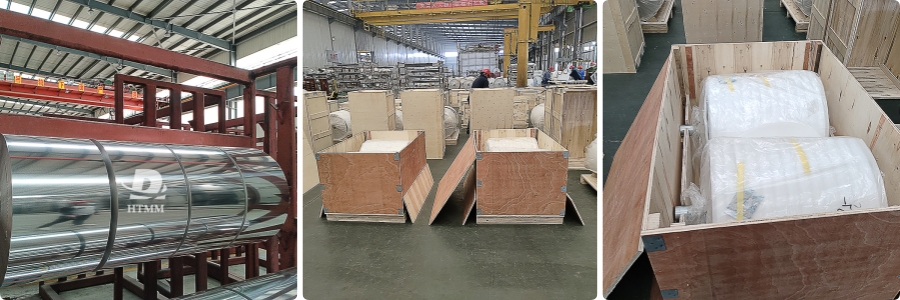
Applying certification criteria on the packaging used for heavy loads guarantees quality as far as there are no fumigated wooden boxes and sealed containers preventing the goods from moisture damage on the way.
Having a reliable source of supply is very important for global market buyers and certified production capacity guarantees stability.
These certifications assure customers that the manufacturer takes quality assurance seriously.
Henan Tendeli Metallurgical Materials Co., Ltd. has been in business since 2009 and specializes in processing aluminum foil, plate, and strip as well as other forms.
The company’s certifications come from FDA, SGS, and ISO 9001 and its annual output is over 100,000 tons of products.
The company ships more than 90% of its output abroad to over 60 countries, serving over 3,000 satisfied customers.
The company’s goal is to offer the highest quality aluminum foil materials.
All the certification proves the commitment of the company towards safety and satisfaction of its customers.

In conclusion, all the top aluminum foil producers in China have FDA certification which will qualify them to sell their products in the US market and hold compliance with EU standards and ISO 9001 for management purposes.
Certification by SGS adds credibility and guarantees purity of the aluminum foil.
Other certifications (BRCGS, Kosher, and Halal) can be helpful when dealing with certain customers.