These can occur for a number of reasons, including impurities in aluminum, defects in the rolling process, excess reduction, and faulty production control.
However, even small defects can compromise the barrier properties of the foil.
Solution: Manufacturers need to use first-rate raw materials and have strict control over the rolling process.
For instance, pinholes and surface defects should be investigated under the accepted quality criteria before shipping.
Foil Breakage During Processing
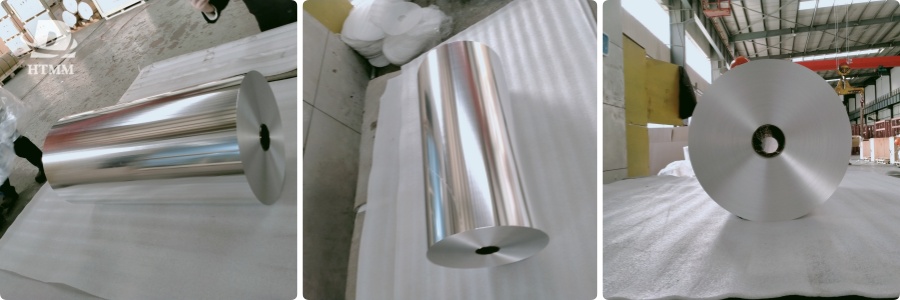
Due to the low thickness of 6 micron aluminum foil, breakage of foil could occur during slitting or lamination, resulting from high web tension, abrupt changes of web tension, improper adjustment of machinery, or rough handling.
Solution: Employ top-notch tension-control systems and properly set processing machinery.
Using appropriate slitting knives, winding tension, line speed, and roller conditions would help mitigate the breakage.
Wrinkles and Uneven Flatness
Wrinkles appear after rolling, slitting, rewinding, or laminating of the foil.
Common reasons include uneven tension, wrong winding, and unalignment of rollers or other processing parameters.
Inadequate Lamination Quality
Insufficient adhesion can arise between the foil and the substrate due to contamination, ill-suited adhesive, missing quantity of adhesive or poor surface treatment.
Solution: The foil must be clean enough for efficient lamination.
Select the adhesive of suitable compatibility and monitor adhesive application rate.
Whenever possible apply sufficient corona treatment of the polymer.
Thickness Variation
Variations in thickness might adversely affect barrier properties, mechanical properties and subsequent converting operations.
Severe values of such variations might result in problems with lamination as well as with high-speed packaging.
Solution: In view of this it is necessary to use precise rolling machinery and monitory thickness variations during the production process.
Tighter tolerances have to be adhered to and inspections have to be conducted during the production process.
Surface Pollution or Oil Residue
Excess rollers’ oil or another type of contamination might interrupt adhesive bonding, printing, coating and other technological operations.
Solution: Controlling rollers’ oiling and the cleaning process is important.
The quality control stage has to recognize whether the foil surface is suitable for further application.
Preventing Issues with 6 Micron Aluminum Foil
A reliable manufacturer of aluminum foil with expertise in producing ultra-thin foil needs to be chosen.
The right alloy and temper should be selected based on the application of aluminum foil as well.
For flexible packaging applications, 8079-O and 1235-O aluminum foil are among the popular options because they possess appropriate deformability and processing properties.
It is vital that manufacturers take care of rolling, annealing, slitting, and rewinding processes.
Proper transportation and storage of aluminum foil will help eliminate moisture, contamination, and defects that can happen to jumbo rolls.
Steps, such as pinhole testing, thickness testing, tensile strength testing, surface testing, and lamination testing, can be implemented before the shipment of the foil to customers.
Selecting a Supplier of 6 Micron Aluminum Foil
When choosing a supplier, it is important to evaluate their expertise in ultra-thin aluminum foils, production technology and their ability to control the quality of the products produced.
A supplier that can deliver a product with consistent thickness and mechanical properties, as well as with a uniform and clean surface, is definitely a good choice.
Another benefit is the availability of customization options.
Sometimes customers may order jumbo rolls exceeding one meter in width, be looking for a certain core diameter or winding specifications.
Reliability of delivery and customer support are also essential, especially for those customers who operate continuous flexible packaging lines.
HTMM manufacturers of aluminum foil provide different solutions of 6-micron aluminum foil according to specific requirements of the customers preventing possible problems when processing and improving production efficiency.
FAQ
What kinds of alloys are used to produce 6 micron foil for flexible packaging?
There are two types of alloys used in the production of foil flexible packaging: alloys 8079-0 and 1235-0, depending on the type of manufacturing process and requirements.
Why is 6 micron foil prone to tearing?
That is due to the use of extremely light substance for its manufacturing.
How can pinholes be avoided in 6 micron foil production?
To avoid this situation, you should control the quality of the raw materials used, improve the rolling process, and control the process manufacturing.
Can 6 micron foil be laminated directly on plastic?
While foil is frequently used as laminate material, it is important to choose the proper adhesive and make sure that the surfaces to be laminated are in the right condition.
Can HTMM provide customized production of 6 micron foil?
Yes, we may provide custom specifications of the foil regarding its dimensions, width, and form of packing.