Alloy selection plays a crucial role in determining the strength, yield of manufacturing process, strength during transportation, and safety for food contact of food containers that are widely used in bulk serving of food, including aviation meal boxes, heavy trays, and mass-serving packaging.
8011 aluminum (a conventional alloy of iron and silicon) is an economic option for making disposable boxes and household foil, whereas 3003 (an aluminum foil alloying with manganese) has proven to be a more suitable option for heavy-duty packaging of food.
3003 aluminum is characterized by an improved metal structure that ensures better mechanical characteristics, processability, and corrosion-resistance in comparison with standard aluminum foil alloy 8011.
The basic reason for the performance difference lies in the alloy composition, mainly because of the 1.0% - 1.5% manganese (Mn) that is purposely added to the 3003 aluminum alloy.
It is known that manganese dissolves in the aluminum lattice and creates fine Al₆Mn intermetallic particles across the entire structure.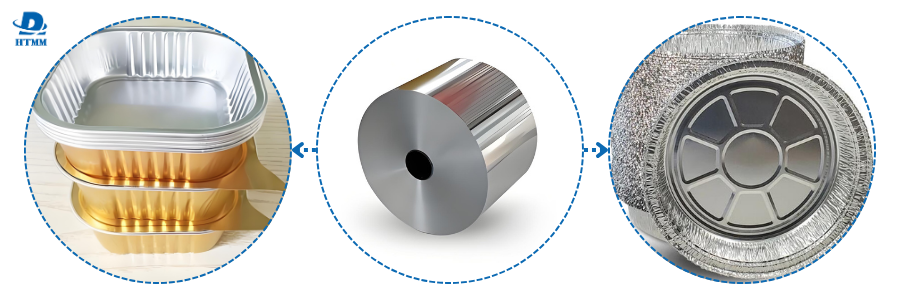
This results in two types of strengthening processes - solid solution and refining of the grains.
These fine particles serve as barriers within the materials, preventing dislocations from moving under force, which makes the metal hard and tough at the same time without becoming brittle.
In contrast, the only reinforcement obtained from 8011 aluminum foil is based upon iron and silicon impurity particles.
These particles allow for improving ductility but only provide limited strength.
Even if the thickness of the two kinds of foil is the same, the microstructure of the 3003 aluminum foil exhibits much higher toughness.
The micro-level advantages of the material translate into numerous tangible physical benefits when working with heavy-duty food containers.
To begin with, the material has amazing stiffness and capability to withstand great loads.
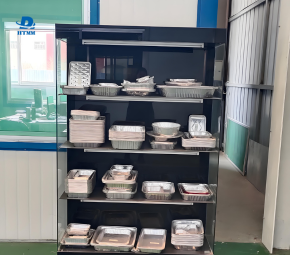
Due to being harder and having a higher yield point, trays and aviation food containers made of aluminum grade 3003 may support the entire weight of hot food.
When lifted by the workers, containers that are full withstand breaking edges and losing shape of the bottom part.
This characteristic is very important for suppliers which deliver food in large portions since grade 8011 aluminum will easily bend, fold, or crush under similar loads.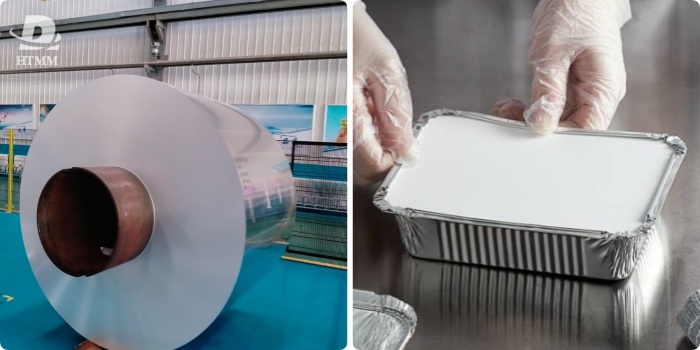
Secondly, aluminum foil 3003 is distinguished by its excellent dent-resistance and multilayer stacking abilities.
In centralized kitchens and takeout delivery, containers are regularly stacked one on top of another during periods of storage.
As a result, upper stacks create pressure on containers down the line leading to deformities of such containers due to inferior properties of aluminum grade 8011 foil.
Aluminum grade 3003 has great resistance to compressive loads and keeps containers in their original shape in spite of the pressure applied during stacking.
Third, 3003 has the right combination of strength and ductility, making it the perfect candidate for deep-drawing and wrinkle resistant mould stamping.
Food container manufacturing plants use high-speed automated stamping systems that produce deep tray types.
During the process of deep drawing, the foil must be deformed and flow through the complex crudeness of the mould.
Mismatches in ductility and strength will certainly result in wrinkled or torn materials or different thicknesses of the wall.
3003 successfully combines good strength with adequate elongation that ensures uniform flow of metal.
As a result we get the product that is clean and wrinkle-free.
Moreover, the aluminum alloy 3003 exhibits superior performance with respect to corrosion resistance opposed to food products containing high salt and acid levels.
Heavy-duty catered food packages often transport foods containing sauces, marinated meats, tomato products, etc. which generally have high concentrations of salt, organic acids, and moisture.
The addition of manganese improves the density and durability of the oxide film on the foil surface that prevents any possibility of corrosion.
The alloy 8011 is less resistant to pitting corrosion resulting from high acid and salt content foods, given identical conditions of exposure.
Being a globally-oriented aluminum foil producer, HTMM follows an all-encompassing product portfolio and provides complete one-stop packaging solutions for customers worldwide.
HTMM uses smart alloy synergy with grades 3003 and 8011.
The technical team analyzes the customer’s application scenarios, container size requirements, and load conditions to provide precise alloy recommendations, such as recommending the use of strong 3003 for heavy-duty banquet trays and food containers on board, and the use of cost-effective 8011 for lightweight takeaway packages that have a short disposal cycle.
This customized approach allows clients to maximize both the performance of their product and the cost of materials.
Apart from food container foils, HTMM’s metal line also includes 8079 and 1235 pinhole-free aluminum foils.
These are higher-grade materials that can be used for aseptic liquid packaging, multi-layer flexible packaging, and other industries that require ultra low pinhole levels and excellent barrier characteristics.
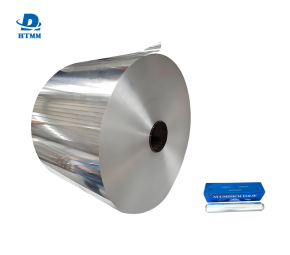
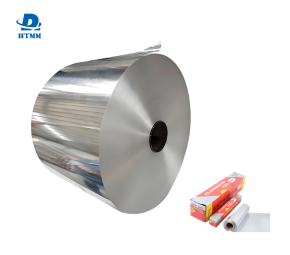
Additionally, HTMM provides large mother reels of 8011 alloy prepared specifically for the off-the-shelf aluminum foil production, so it meets the demands of kitchens all over the world.
Thickness, width and temper options are fully customizable within any alloy series.
HTMM has the latest cold and foil rolling technology to ensure that mechanical properties are adjusted to meet the stamping specs and other requirements of the customer.
The high-tech production site in China has been equipped with top-level rolling mills and modern flatness monitoring machinery.
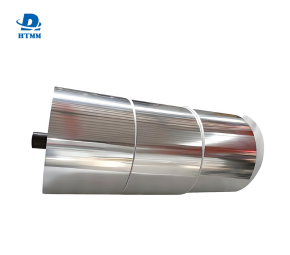
The sophisticated equipment ensures good thickness precision, well-balanced flatness and reliable properties of the finished foil rolls.
HTMM applies strict quality control methods at all production stages.
All products manufactured by HTMM are compliant with the international regulations concerning food safety (FDA and EU).
The company ensures that its aluminum foil is not dangerous and can be used in contact with food (hot, acidic and saline).
Due to the heavy weight of jumbo foil rolls as well as their vulnerability to moisture damage during shipping across oceans, HTMM uses advanced cross-border transportation methods.
The wooden crates which do not require fumigation along with the tight sealing of the packaging help to avoid water penetration, mechanical damage and oxidation.
By circumventing the involvement of intermediaries in the transaction process, HTMM is able to sell its products to the customers at very profitable prices.
With a large volume of monthly production capacity, the company can establish effective and long-term contracts with large food packaging manufacturers operating globally.
In conclusion, 3003 aluminum foil, which has been reinforced with manganese, is unique in its suitability for manufacturing food packaging of industrial strength.
The fact that it possesses excellent rigidity, resistance to stacking, a good ability to undergo deep drawing and high corrosion resistance provides for finding the solutions to many issues existing in catering packaging.
By cooperating with HTMM, companies engaged in the production of packaging can benefit from high professionalism of alloy consulting, wide choice of materials, flexible characteristics of aluminum foil, certification relevant to food grade quality and high reliability of logistics.