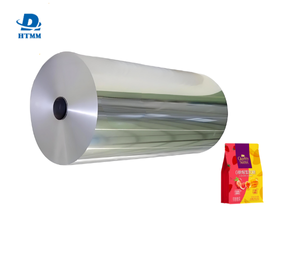
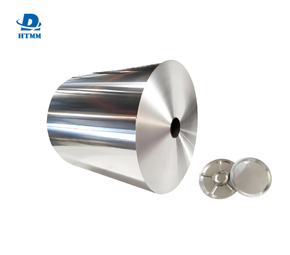
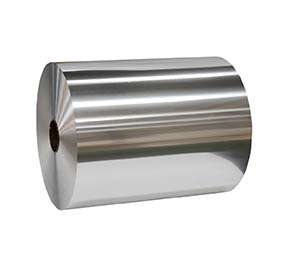
There is no single "best" alloy of aluminum foil for flexible packaging.
The ideal aluminum alloy depends on your final packaging structure, converting process and product fill.
Three alloys dominate flexible packaging – 8011, 8079 and 1235.
Each alloy balances the properties you need for a flexible packaging product while also being the most affordable option from Chinese mills.
You need the right alloy for the structure, the converting line, the fill and the final market.
Choosing the wrong product can lead to web breaks, pinholes, poor lamination and lost profits.
We help you understand the key differences in alloys and help you select the right one for your application.
Structural considerations, converting line specifications, final product needs all play a part.
Why Alloy Choice is Critical for Flexible Packaging
There are many variables that determine which alloy can deliver the best combination of performance, processability and economy.
Material properties, surface finish and temper all influence converting speed, breakage and output quality.
For flexible packaging, compatibility with adhesives, ability to stretch without breaking and barrier properties are interconnected.
Structure – PET/Al/PE or Paper/Al/PE – dictates the total foil thickness to achieve adequate barrier.
Too thick raises costs, while too thin reduces effectiveness.
Finishing processes require a certain roughness, surface cleanliness and flatness to optimize lamination.
Thickness – from 6 to 12 microns – affects both performance and cost.
Thinner foils need stronger alloys.
Barrier performance – pinholes and oxygen transmission – influences alloy choice.
Poor selection causes rejects, downtime, product spoilage.
Total cost of ownership is affected by material price, reject rate and conversion line output.
The goal is to find an alloy that is just right.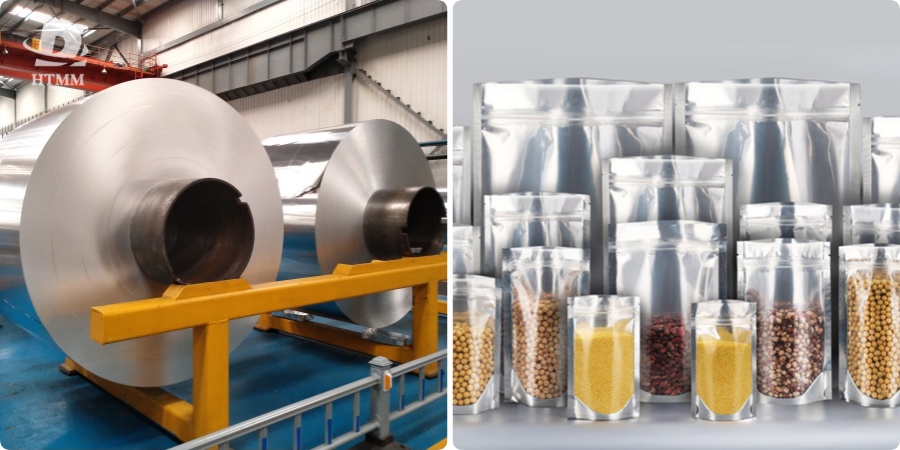
Key differences between 8011, 8079 and 1235 metal alloys
The most common flexible packaging alloys are 8011, 8079 and 1235.
Some others are available but less common in the industry.
They all have their strengths and applications where they shine.
While they use the same base elements, each alloy has a different purity level, mechanical properties, elongation capabilities, pinhole control and cost profile.
8011 –Versatile, Economical and Most Widely Used
The 8011 alloy is widely used in flexible packaging applications due to good mechanical strength, moderate pinhole counts and reasonable price point.
Tensile strength is typically in the 65‑110 N/mm range, with elongation of at least 1.5%.
Recommended for structures where the total thickness is greater than 10 microns and cost is a concern.
Pinhole counts are generally acceptable at 7 microns.
Popular in China but also produced globally.
8079 – High Performance at Thin Gauges
The 8079 alloy has better purity, elongation and pinhole performance for thinner gauges, 6 to 9 microns.
Superior performance in pinhole resistance at thin thickness makes it the ideal solution for coffee and pharmaceutical packaging where shelf life and protection requirements are high.
The alloy also benefits high‑speed web processing and easy handling.
Pinhole counts at 7 microns typically under 200 holes/m2.
1235 –Softest alloy with good pinhole performance
This high‑purity alloy is the softest available and offers excellent elongation and pinhole resistance at thin gauges.
It is well suited to double zero packaging for coffee or pharmaceutical blister packs.
Which alloy is best for your flexible packaging application?
Food, snack and dried food packaging often can utilize the more budget‑friendly 8011 or the higher‑barrier 1235 depending on fill needs.
Coffee and pharmaceutical packaging demands the high‑barrier 8079, or the 1235 alloy.
‑ Coffee – requires pinhole‑free barrier at 7 to 9 microns (preferred choice – 8079 or 1235)
‑ Pharma – demands pinhole free barrier at 7‑9 microns, needs highly controlled manufacturing environment – preferred choice – 8079 or 1235
‑ Blister packs – require pinhole free 7‑9 micron foil for high‑speed filling
‑ Structure – PET/Al/PE or paper/Al/PE structure at 6 to 9 microns. Best material for the application at lowest cost. Take flexibility into account, especially at the high‑speed converting lines.
‑ Pinhole resistance at 7 microns – less than 200 holes/m2 (some applications demand even less)
‑ Surface quality – flatness and oil content less than 2 ml/m.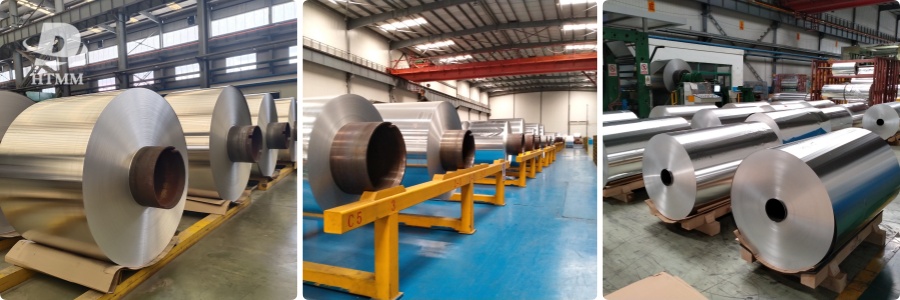
Environmental controls in manufacturing for pharma and food
‑ Core Diameter, Gauge, Width, Outer Diameter – determined by converting line specifications
‑ Winding quality – flatness, tension, and tightly wound rolls determine how quickly you can run
‑ Corrosion resistance – at 7‑9 micron to prevent product contamination.
Other specifications needed for flexible packaging buyers before ordering
The basic starting point for flexible packaging is the structure.
PET/Al/PE at 7‑9 microns or paper/Al/PE at 7‑9 microns provide the best understanding of which alloy will deliver high throughput.
Assure your supplier that the foils are handled under condition that optimize surface quality.
For low porosity pharmaceuticals at 7‑9 micron; take into account –
‑ Width for the given converting process.
‑ Core diameter or ribbon roll for smooth running.
‑ Pinhole count – some pharmaceutical applications require pinhole counts under 50/m2 at 7 microns.
‑ Oil content – less than 2 ml/m2
‑ Elongation at 7‑8 microns – high is best for converting and slitting; strength for breaking webs on high‑speed lines.
‑ Surface cleanliness – clean foil to ensure good lamination in packaging.
How do I decide which alloy to use in my flexible packaging line?
To decide on the best alloy, begin with the final product structure in mind.
Even the same structure at different thicknesses could benefit from a different alloy.
Validate material compatibility through sample trials.
Pinhole counts for 7‑9 microns must be considered, as well as reel quality.
Watch process lines for web‑breaking, web‑tension and breakage.
Total cost including rejects versus high reel speed can make some alloys less affordable in the end.
We help you compare cost, quality and performance to ensure a final decision.
HTMM supplies flexible packaging aluminum foil for producing flexible packaging such as oil and snack food packaging, pharmaceutical and cigarette foil, medical foil, and coffee foil.
We offer the best quality by matching total gauge and alloy, along with Winding core diameter, width, and maximum reel outer diameter to your unique production needs.
We also match alloy, gauge and width to laminate for more effective product development.
About HTMM Henan Tendele Metallurgical Materials Co.,Ltd.

Our company specializing in the production of aluminum foil and other aluminum alloy products.
The company was founded in 2009.
The company's operations radiate throughout the country and the world, exporting to more than 60 countries.
There are more than 3,000 customers in the world.
The company's annual output of 8011 and 8079 aluminum foil exports to more than 1.2 billion meters.
The annual output of 1235 alloy 1,000 tons of foil exports to the Middle East, South America, Southeast Asia, Africa and other countries and regions.
the company's supply of aluminum foil complies with the European Union health standards, safe and reliable, good quality.
Company products – 8011 aluminum foil, 8079 aluminum foil, 1235 aluminum foil, foil jumbo roll etc.